
Play, exercise and a healthy weight
- Watch for
- A change in interest, pace or familiar movements
- Ask your vet
- Activity and feeding that suit your cat
- Related
- Feeding, indoor life and mobility
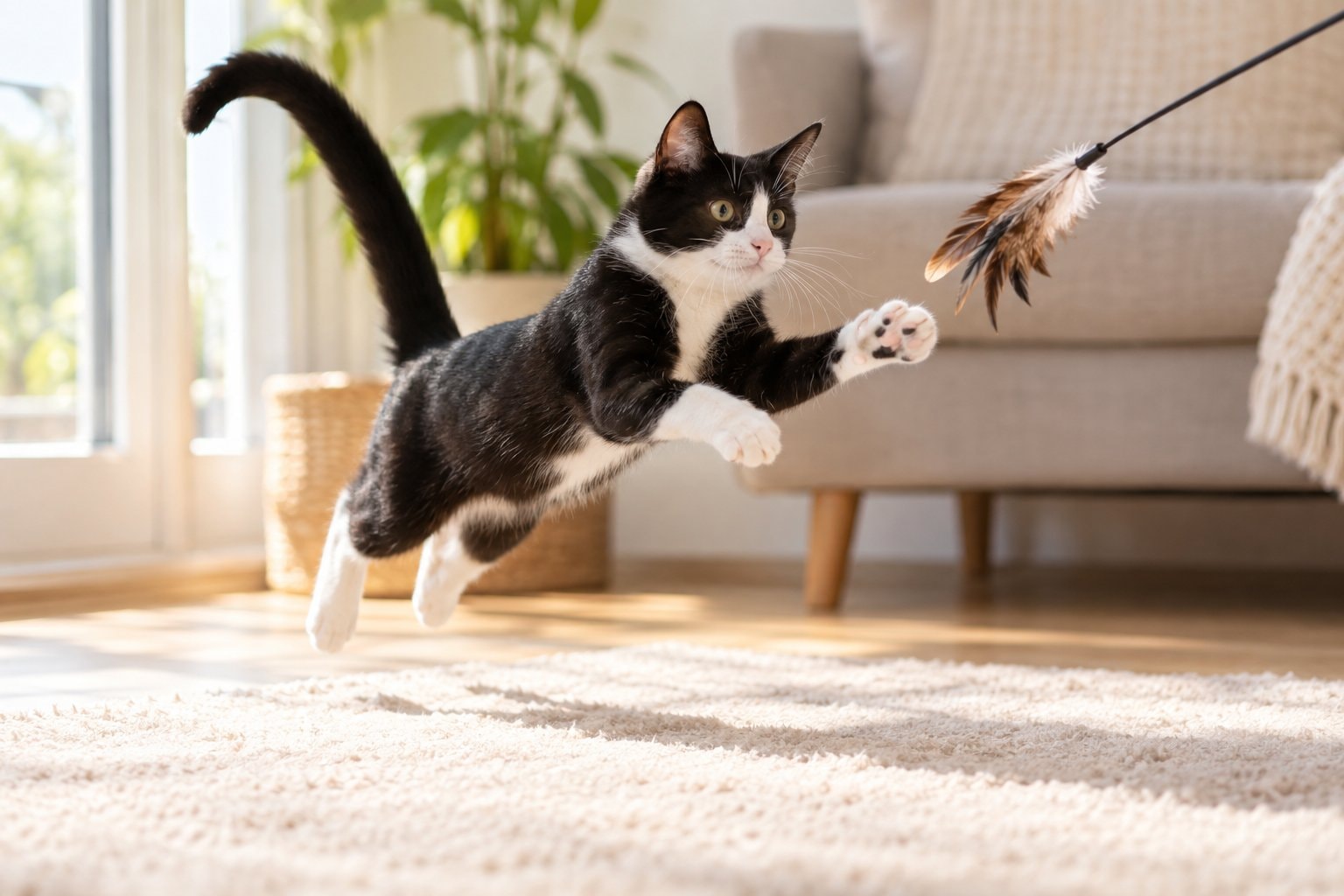
Play can be a familiar part of sharing a home with a cat: a crouch behind a chair, a paw reaching after a moving toy, or a quick dash across an open patch of floor. The useful aim is an activity your cat can choose and enjoy. Its pace, interests and comfort matter more than an ambitious routine. Begin with the cat in front of you, and keep questions about a changing activity level separate from questions about how to make a game more interesting.
Think like a small hunter
Wikipedia’s account of cat play describes games involving stalking, chasing and pouncing as related to hunting behaviour.
You can use that description to plan a simple game. Move a toy along the floor and away from the cat, pause it behind a safe obstacle, and allow time for watching as well as chasing. A game does not need constant fast movement to be engaging. A cat waiting quietly may be interested rather than bored. Give it room to approach and room to leave.
Keep the setting easy to navigate. Clear the route of fragile objects and check that a chair, rug or low obstacle is steady. Leave a comfortable resting place nearby. Use a toy rather than inviting the cat to wrestle with your hands. When interest fades, finish the game and put loose play materials away. The point is shared activity, not persuading an unwilling cat to continue.
A routine that fits the household
Short daily opportunities can be easier to fit into home life than an elaborate exercise session. Choose a quiet moment when your cat seems interested, rather than waking it to meet a plan. Try a familiar game and notice what it chooses to do. Some cats like movement along the floor; others spend longer watching before reaching or pouncing. Adjust the game to that response rather than treating every cat as equally energetic.
Consider who else is present. In a home with several cats, a confident cat may reach a toy first while a quieter companion waits at the edge. Offer space for separate games where needed, and avoid crowding a cat in a corner. The indoor-life page looks more closely at rest, hiding places and access to resources. A pleasant play area belongs within that wider home arrangement.
Food puzzles and searching games
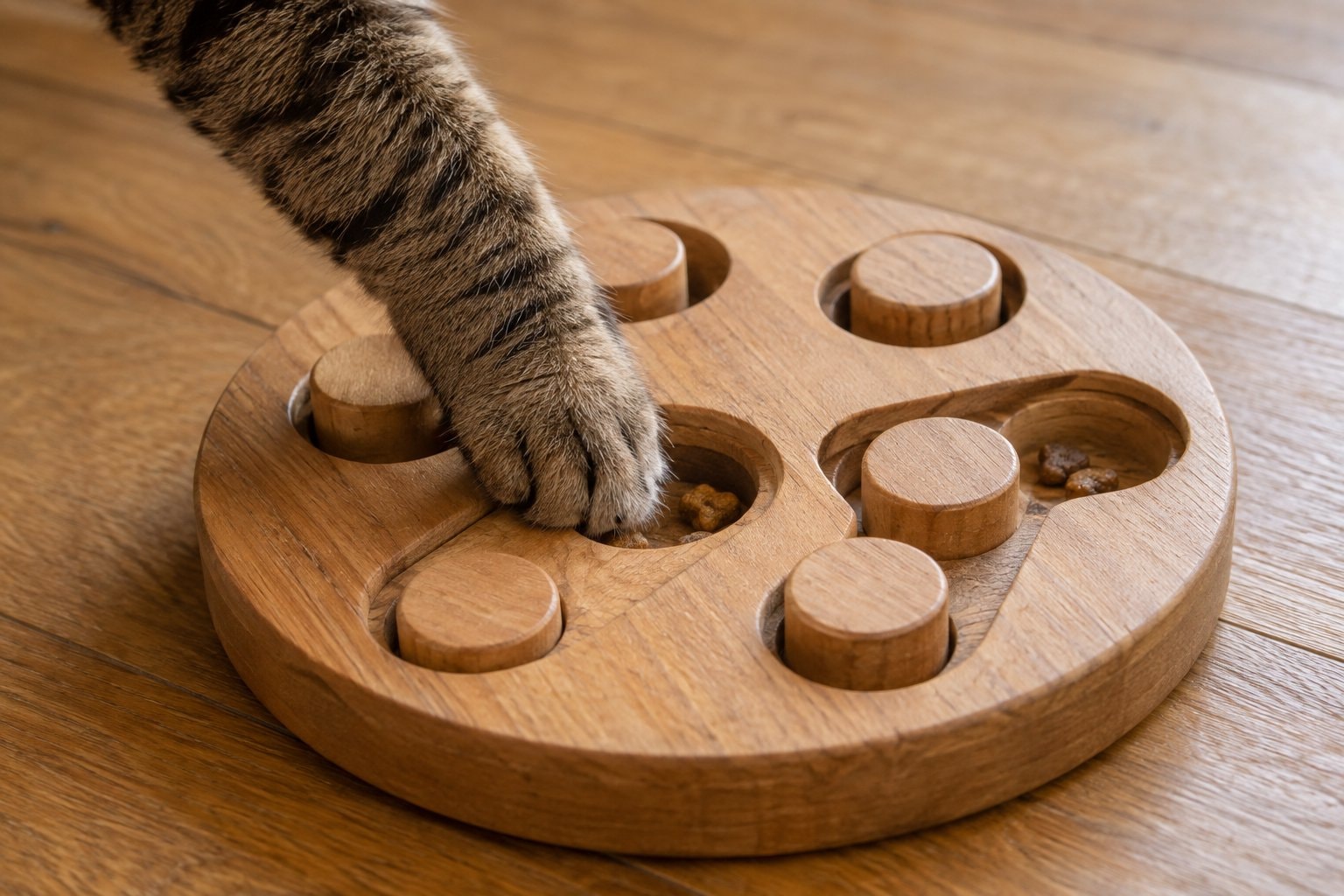
A food puzzle gives a cat something to investigate while reaching for part of its usual food. Keep the task simple at first, with food easy to find and the puzzle set on a stable surface. Watch whether the cat seems interested, hesitant or frustrated. A puzzle is an option, not a requirement, and a cat that prefers its familiar bowl can still have other forms of play.
Count food used in a game as part of the food your cat eats, rather than as an unlimited extra. Ask your veterinarian how a puzzle fits into the cat's normal feeding plan. There is no feeding amount or weight-loss plan to follow on this page. The feeding guide explains the meal and weight questions that belong in that discussion.
The AAFP/ISFM Environmental Needs Guidelines consider a cat’s living environment and the opportunity to express natural behaviour.
That wider approach is a useful reminder to avoid judging a cat's day only by the time it spends chasing a toy. Rest, choice and a place to retreat also belong in a comfortable household routine. A cat can be offered a game without being pushed to take part.
Keep weight questions with your veterinarian
The Cornell Feline Health Center recommends asking a veterinarian to help assess a cat’s ideal weight and any changes needed to its feeding.
Bring an honest account of meals and extras to that conversation. Include food left out for grazing, food used in puzzles, and anything other members of the household offer. A description of how food is shared can be especially useful when cats have different habits. Avoid changing meals sharply because a cat looks rounder or less active. Ask how its weight can be assessed and followed over time.
A review of obesity in companion animals examines diet, physical activity, behaviour and environment among the factors involved.
The useful point for a cat owner is that weight deserves attention within ordinary veterinary care. A game cannot tell you whether a cat is at a suitable weight, and a scale reading without context cannot explain a change. The veterinarian can put the cat's body condition and health alongside the household routine. Take questions about both food and activity, rather than assuming either detail gives the whole answer.
Easy courses at home
Some cats enjoy an agility-style route through hoops and tunnels at home. Keep the route low, open and easy to leave. Introduce a simple element as an invitation and let the cat investigate at its own pace. There is no event to train for and no performance standard to meet. A cat choosing to walk through a tunnel has participated just as much as a cat that runs through it.
For a cat that moves less comfortably, ask your veterinarian what kind of activity suits it before adding obstacles or jumping. The mobility page explains why a change in movement deserves attention. Resting more or avoiding a game does not, by itself, tell you the cause. A low-pressure invitation is different from asking a cat to prove that it can still move as it once did.
Notice when play changes
Keep a familiar game in mind as a point of comparison. If your cat usually approaches it but starts turning away, describe that change to your veterinarian. Note whether jumping, grooming, appetite or interaction has changed as well. You do not need to keep repeating the game to test the cat. A clear account of what you noticed is enough to begin a conversation.